
The Vertical Slide of Thinking in Cinema
The Lady From Shanghai and the Small Screen by my Bed

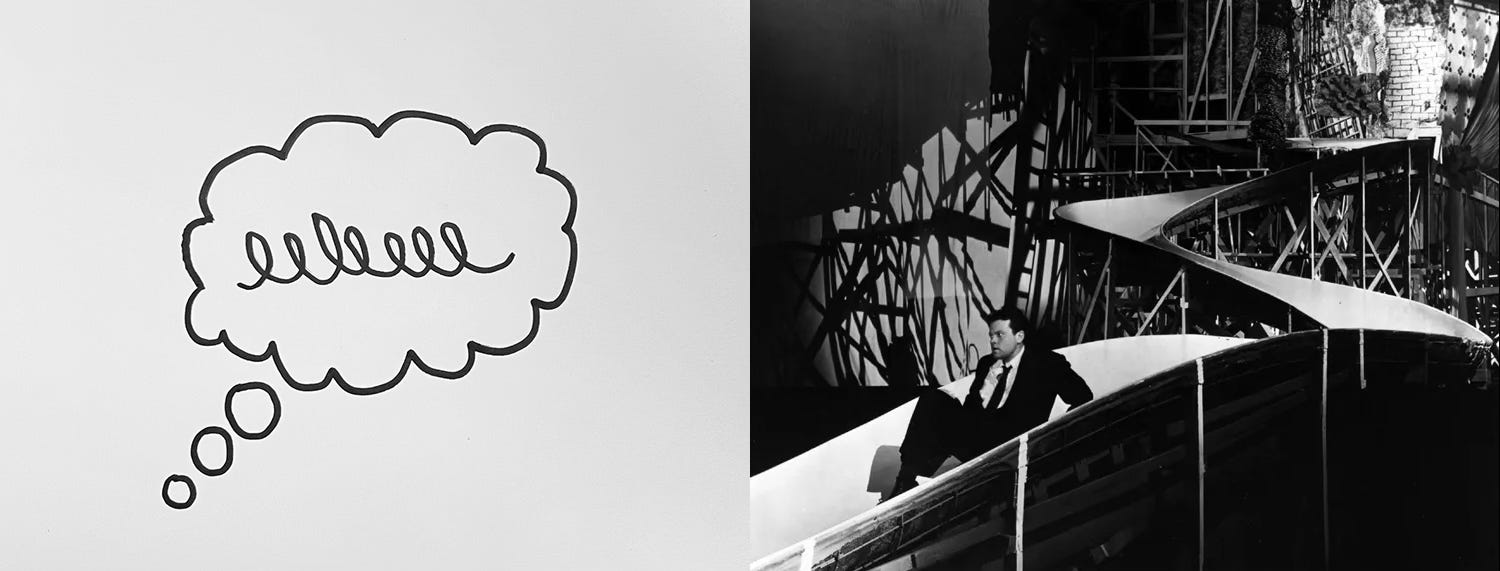
When I turn the monitor connected to my computer towards the bed to watch a movie, the screen becomes small in the distance. To paint a picture of this setup all you have to do is imagine one of those small flat screen TVs you would see in the opulent kitchen of an American movie, but just focus on the screen and then imagine I have a desk right next to my bed.
There is no way of lying in bed in a sleeping position to watch something. Both the desk and the bed face the same direction, so the only thing I can do is position myself sideways, against the wall, and use the bed as if it were a sofa. But last night, even if it wasn’t lying down I fell asleep watching Orson Welles’ The Lady From Shanghai (1947) hugging a pillow. I remember falling asleep when Michael O’Hara (Welles) kisses Elsa (Rita Hayworth) in the aquarium, and I made a mental note to continue watching the film from that point and closed my eyes, just listening to the rest of the picture.
Film theory was different before VHS. Theorists like Stanley Cavell were forced to write from memory, remembering a film was just as important as watching it. In the preface to The World Viewed: Reflections on the Ontology of Film (1979, xix) Cavell equates his memories of cinema with the writing of his own autobiography. “The importance of memory goes beyond its housing of knowledge. It arises also in the way movies are remembered or misremembered.” (1979, 12) I confess I have never rewatched a film for any of the essays I have written, and that I like relying on my misremembering of cinema, that there is a possibility that all my work is based on an alternate reality I have misremembered to fit it.
Yet, in the golden days of film theory no writer finished a film the next day. This, amongst other things, is something you are not supposed to do, and I wonder if all the commandments of movie watching come from a medium specific origin, or a resentment that the pictures left the movie house. I feel as if I should point out that I do agree with David Lynch that if you watched a movie on your phone you didn’t really watch it. But also, that whenever I hear this statement I question myself about who these movie-watching-mobile-phone-users are.
Setting up the screen like I did to watch The Lady From Shanghai felt like a necessity. I can’t quite explain this note I made while watching the film. The computer monitor next to the bed is not exactly a unique setup, but it does feel like a niche mode of viewing. It has a homely feeling and it reminds me of being in film school, when my obsession with films seemed much more utilitarian and direct. Everything was more material too, my school had a special DVD library for film students, and I remember renting Sergei Eisenstein’s October (1927) to impress one of my professors. Back then, my daily film watching seemed more straightforward, affect based rather than muddled by a need to always the picture evoke thought.
The Lady From Shanghai is carried by the protagonist’s (Michael O’Hara) voice over. In the opening scene his thoughts or feelings, precede his speech. This sets a tone for the “ideas” preceding the film. In the closing sequence inside the crazy house, particularly in the beginning, when O’Hara walks on screen, from one side of the frame to the other, and the VO hovers over the shot, his thoughts are placed on him and move across the screen. Thought as reflection becomes a voice over; when we see and hear a character thinking on screen, forehead and speech connected by montage, we see it as true that we really do think as if we were writing without record, but I still don’t believe that is real.
Welles literally moves down the crazy house on a spiraling slide. Kaleidoscopic effects and cross-dissolves between close-ups of the actors’ faces and elements of the crazy house follow that sequence and muddle the screen. At the same time that they delimit the film, make the images dreamier than the realistic index of the rest of the movie, and are looser than the harsh black and white contrasts we have come to know film-noir for, they also attest to the impossibility of directly placing or representing thought in cinema. Maybe we only think we think in words?
I always imagine thought as a cartoonish thought-bubble, and inside of it is a horizontal spiral representing the simply abstract as if it were written incomprehensibly—if someone could read minds, that’s what I imagine they would see, together with the looping sound of a woosh—Welles slide looks similar, but it spirals vertically to a limit, while my imagining of thought remains possibly infinite. It is at this limit that the film breaks into kaleidoscopic effects and cross-dissolves in a hall of mirrors, until the correct reflection is shot down and the end of the film is revealed once again as narrative.
In Cinema II: The Time-Image, Deleuze (1989) speaks of virtual-images, which time-images always are. Simplified, I see the time-image as a shot or sequence of shots which project the invisible idea of the film, or the inexpressible thoughts of a character back onto the viewer. The image is indeed virtual because it is untranslatable.
“It is the virtual image which corresponds to a particular actual image, instead of being actualized, of having to be actualized in a different actual image.” (Deleuze 1989, 83) What stands out in Orson Welles’ career is his need to actualize himself in the picture, director as correspondent to his own virtual-imagery. Welles, like any other director, is not only able to watch the attempt of visualizing his own thinking process, but to also place himself in it. While a director-actor like Woody Allen may use his cinema for a reenactment of his own fantasies, I think Welles is more interested in remaining a part of his own ideas.
Confronted by the realization that the femme he was in love with was indeed fatale, Welles/O’Hara slides down the spiral of the crazy house into a hall of mirrors: kaleidoscopic camera work, cross-dissolves and images melt together. It is an easy representation of a state of confusion, one which is timed to the sequence, as the final shot of the film is simple and direct in comparison. A question that eludes me in my work is: where is thought placed in cinema? A question I often get asked is: what is thought?
Thought is maybe here the idea behind the film, the thoughts of the protagonist, verbalized as a voice over, the raw emotion of confusion, maybe, during the crazy house scene. My interest in “thought” and its practical placement in cinema is that each person’s thinking is invisible to the other, and when something invisible is put on screen it inherently gets reduced or limited by the image and the audio. But in the shot of the slide, against the darkness of a soundstage, the frame loses its boundaries against the dark bezel of my cheap HP EliteDisplay E232 monitor and I watch Orson Welles slide down a world of his own making, spiraling in his mind until he reaches the ground, shaped like a target.
The last thing I wrote on my notebook before falling asleep was: ‘think about Douglas Sirk tomorrow.’ The next time someone asks me: what is thought? I’ll come prepared: thought can only be cinema.
CITATIONS:
Cavell, Stanley. The World Viewed. Cambridge, MA: Harvard University Press. 1979.
Deleuze, Gilles. Cinema II: The Time-Image. London, UK: Bloomsbury. 1989.